Behavioral Insights Fueling Tailored Retention Approaches in Online Betting Environments
Noah Klein · Aug 10, 2026

Behavioral Insights Fueling Tailored Retention Approaches in Online Betting Environments
Virtual betting platforms rely on behavioral insights to shape retention strategies that adapt to individual user patterns rather than applying uniform tactics across the board. Researchers at institutions tracking digital gambling trends note that data from player interactions, session lengths, and decision-making processes provide the foundation for these customized approaches. Platforms collect information on betting frequency, preferred game types, and response to various prompts, then apply algorithms to predict when users might reduce activity or disengage entirely.
Core Behavioral Patterns Informing Strategy Development
Studies in behavioral economics applied to gambling environments reveal recurring patterns such as variable reward sensitivity and habit formation loops that operators monitor closely. Data from multiple jurisdictions shows users often exhibit increased engagement following near-miss outcomes, while prolonged losing streaks correlate with higher churn rates unless intervention occurs at specific thresholds. Platforms use these observations to trigger personalized communications or interface adjustments at moments when continued participation seems most likely to wane. According to findings published by the Australian Gambling Research Centre, operators who segment audiences based on these behavioral signals achieve measurable differences in session continuation compared with those using generic outreach methods.
Loss aversion emerges as another key factor, where users respond differently to messages framing potential recoveries versus new opportunities. Research teams analyzing large datasets from European platforms have identified clusters of players who react strongly to progress indicators within loyalty frameworks, prompting developers to design retention tools around visible milestones and incremental achievements. These elements combine with real-time monitoring systems that adjust difficulty or feature availability based on observed play styles.
Implementation Through Data Segmentation and Machine Learning
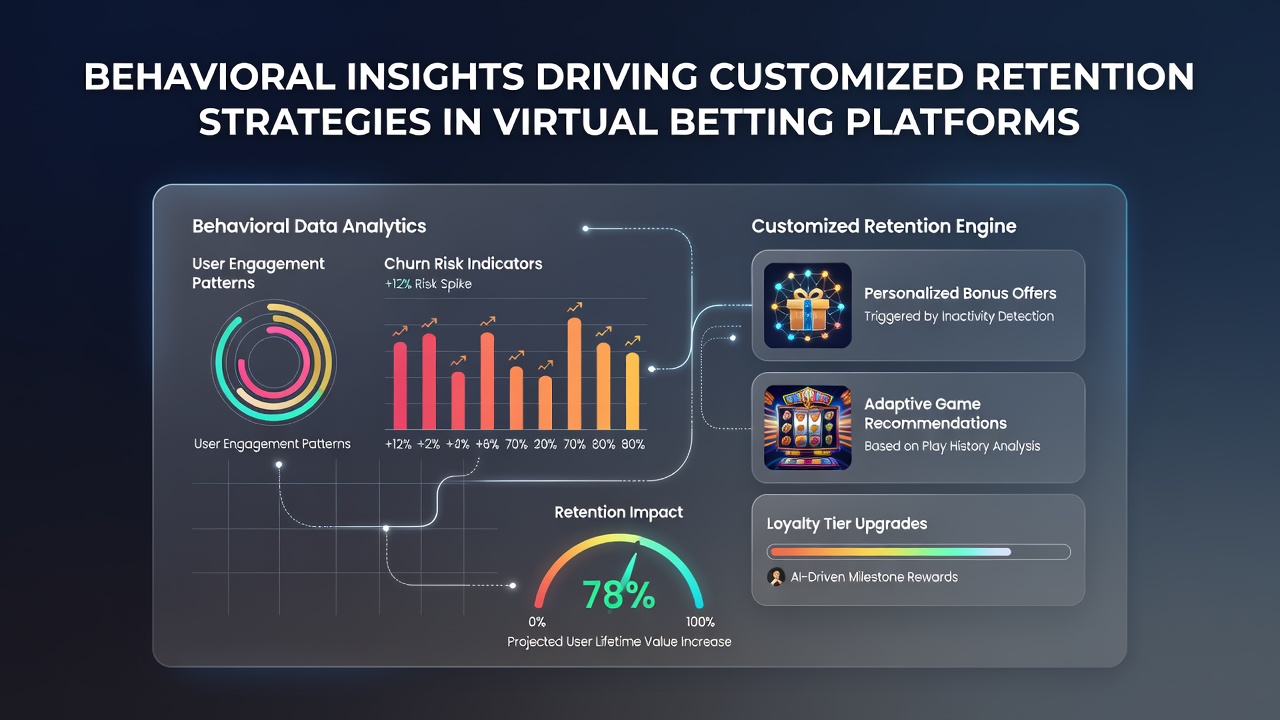
Operators segment player bases using machine learning models trained on historical interaction records, enabling the creation of distinct retention pathways for different behavioral profiles. One common division separates high-frequency casual participants from those showing signs of strategic or risk-oriented decision making. Platforms then deploy tailored notifications, game recommendations, and account features that align with each group's demonstrated preferences. Figures from industry reports indicate segmentation accuracy has improved notably since 2024, allowing more precise timing for retention interventions.
August 2026 marks the scheduled rollout of updated data protection standards across several North American regulatory frameworks, which will require explicit consent mechanisms for behavioral tracking used in retention programs. Platforms are already adjusting their systems to maintain compliance while preserving the granularity needed for effective customization. This shift follows earlier guidelines issued by bodies such as the Nevada Gaming Control Board, emphasizing transparency in how player data informs personalized experiences.
Examples of Customized Retention Tactics in Practice
Take one major platform that introduced dynamic interface modifications for users displaying declining session times. The system detects reduced login frequency and responds by highlighting previously favored game categories or simplifying navigation to reduce friction. Observers note similar approaches in European markets where operators integrate social proof elements, such as anonymized peer activity summaries, for players who respond positively to community signals. These tactics derive directly from analysis of clickstream data and exit surveys rather than broad assumptions about user motivation.
Another documented case involves platforms that adjust reward structures based on detected risk tolerance levels. Users identified through behavioral scoring as more conservative receive options emphasizing steady, smaller returns, whereas those showing tolerance for volatility encounter different progression systems. Research from the University of Sydney's gambling studies unit highlights how such differentiation correlates with extended platform tenure across tested cohorts. Integration with responsible gaming tools further refines these strategies by incorporating self-exclusion prompts or limit-setting reminders calibrated to individual play histories.
Measurement and Ongoing Refinement Processes
Retention effectiveness gets evaluated through metrics including return rates, average revenue per user over defined periods, and voluntary account reactivation following dormancy. Teams track these indicators against control groups exposed to non-customized strategies, revealing incremental gains attributable to behavioral targeting. Continuous model updates occur as new data streams refine the underlying algorithms, ensuring strategies evolve alongside shifting player behaviors. Platforms operating across multiple regions adapt their approaches to account for regulatory variations, such as those enforced by provincial authorities in Canada or state-level commissions in Australia.
Conclusion
Behavioral insights continue to drive the evolution of retention strategies within virtual betting platforms by translating observed user patterns into actionable, individualized interventions. Data segmentation, machine learning applications, and region-specific compliance adjustments form the operational backbone of these efforts. As regulatory landscapes develop through 2026 and beyond, platforms maintain focus on refining these methods while aligning with transparency requirements from diverse oversight bodies. The result remains a set of retention frameworks grounded in empirical observation rather than generalized assumptions about player engagement.